
23 October, 2026
Greenhouses provide controlled environments for crop cultivation, but excessive solar heating can make maintaining suitable growing conditions particularly challenging in hot and arid regions. Conventional greenhouse coverings allow sunlight to enter but offer limited control over unwanted solar heat, often increasing the demand for energy- and water-intensive cooling.
Researchers at King Abdullah University of Science and Technology (KAUST), led by Prof. Qiaoqiang Gan, have developed a thermochromic hydrogel smart window that automatically regulates sunlight and reduces heat accumulation without requiring external electrical power. The technology offers a promising approach to passive greenhouse cooling while maintaining the light needed for plant growth.
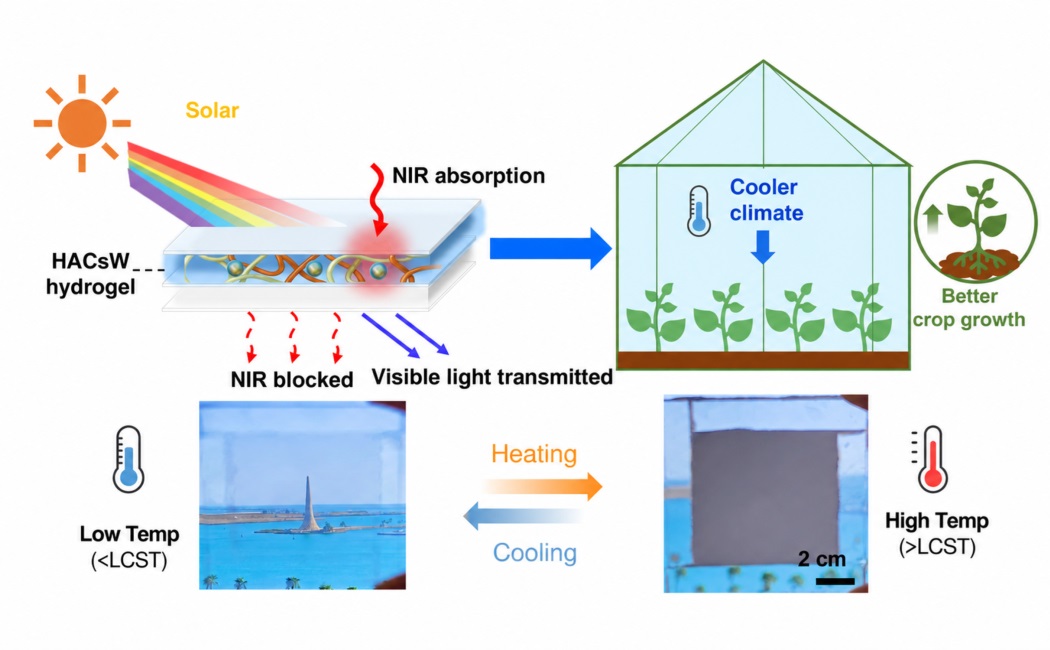
The smart window combines a temperature-responsive hydrogel with cesium tungsten bronze (Cs₀.₃₃WO₃) nanoparticles and a gel–air bilayer structure. At lower temperatures, the hydrogel remains transparent, allowing visible sunlight to pass through. As the temperature rises, the hydrogel becomes translucent and scatters more incoming sunlight, reducing solar heat transmission. Meanwhile, the incorporated nanoparticles absorb near-infrared (NIR) radiation, which contributes significantly to solar heating, and help accelerate the thermochromic response under sunlight.
Unlike conventional thermochromic hydrogels that primarily rely on temperature-dependent changes in transparency, the new design integrates NIR shielding, adaptive solar modulation, and thermal insulation within a single window system. The additional air layer further reduces heat transfer, providing another mechanism for controlling greenhouse temperatures.
Laboratory measurements demonstrated that the smart window maintained a visible light transmittance of 74.3% in its transparent state while achieving a solar transmittance modulation of 37.5%. In its high-temperature state, the window blocked up to 89.6% of incident near-infrared radiation, effectively limiting unwanted solar heat transmission.
To evaluate its practical performance, the research team conducted outdoor greenhouse experiments in Saudi Arabia, where intense sunlight and high ambient temperatures create demanding conditions for crop cultivation. Compared with conventional plastic coverings, the smart-window system reduced greenhouse soil temperatures by up to 12 °C, creating a more favorable environment for plant growth.
More importantly, greenhouse cultivation experiments demonstrated a 66.7% increase in crop yield compared with conventional plastic panels. These results highlight the potential of adaptive solar regulation not only to improve thermal conditions but also to support agricultural productivity in water-stressed environments.
Beyond greenhouse agriculture, this approach could inspire future smart-window technologies for buildings, vehicles, and other transparent enclosures where effective solar heat management is essential. The work provides a pathway toward climate-adaptive materials that reduce cooling requirements while making better use of natural sunlight.
The study, titled “Near Infrared-Blocking Thermochromic Hydrogel Smart Windows for Passive Solar Heat Control,” was published in ACS Applied Materials & Interfaces.
Publication: ACS Applied Materials & Interfaces, 2026, 18 (40), 54919–54930.