
18 March, 2026
Thuwal, Saudi Arabia — Researchers at King Abdullah University of Science and Technology, led by Professor Qiaoqiang Gan, have developed a new class of thermochromic hydrogel-based smart windows that enable efficient passive cooling without electricity. The technology dynamically regulates sunlight transmission based on temperature, offering a scalable and sustainable solution for vehicles, buildings, and greenhouses.
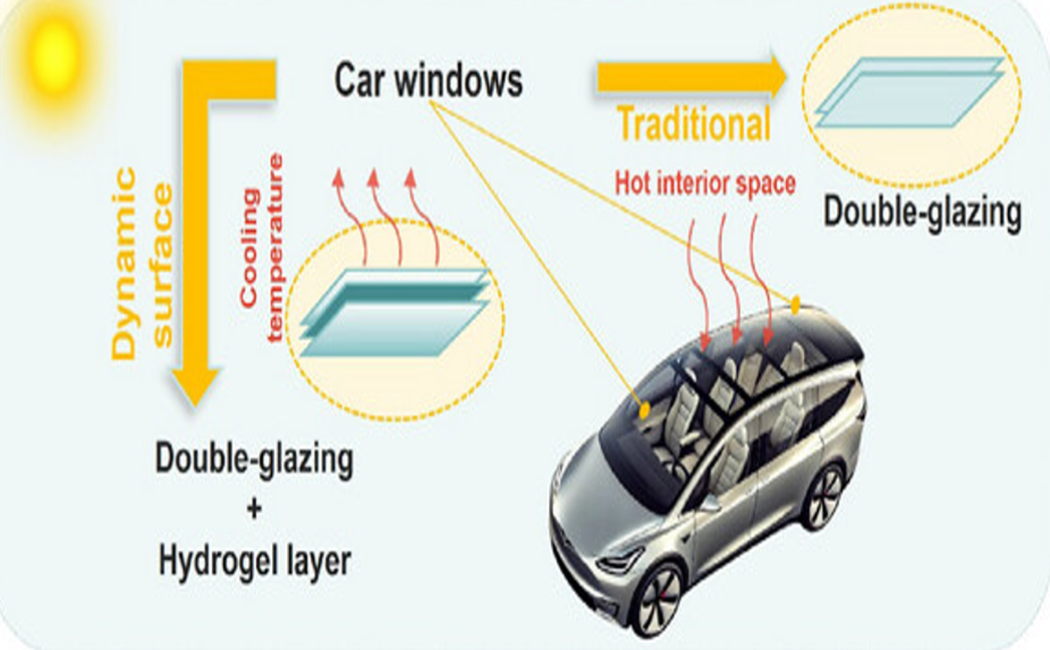
Solar heating through windows is a major contributor to rising temperatures in enclosed spaces such as parked vehicles, often posing safety risks and increasing reliance on energy-intensive air conditioning systems. To address this challenge, the KAUST team designed a hydroxypropyl cellulose (HPC)-based thermochromic hydrogel that automatically switches between transparent and opaque states depending on ambient temperature.
“This material responds directly to temperature changes, allowing it to block solar heat when needed and remain transparent under cooler conditions,” said Gan. “It provides a fully passive approach to thermal management without external energy input.”
The innovation lies in a dual-network hydrogel structure composed of HPC and polyacrylamide (PAAm), which enhances mechanical strength and water retention. By incorporating calcium chloride (CaCl₂), the researchers achieved precise control over the transition temperature, tuning it across a wide range from 15 °C to 42 °C to suit different climates and applications.
Encapsulated within acrylic panels, the hydrogel functions as a smart window that can significantly reduce solar heat gain. In real-world tests, the system lowered vehicle interior temperatures by up to 10 °C under direct sunlight. Outdoor experiments further demonstrated temperature reductions of up to 14 °C in enclosed environments, highlighting its strong passive cooling capability.
A key advantage of this technology is its durability and stability. The smart window maintained consistent optical and thermal performance over more than 400 heating and cooling cycles, indicating its suitability for long-term use. Additionally, the material is composed of low-cost, environmentally friendly components, making it attractive for large-scale deployment.
Unlike conventional smart window technologies such as electrochromic or photochromic systems, which often require external power or complex fabrication processes, this hydrogel operates entirely passively. It also achieves high solar modulation efficiency, effectively reducing incoming solar energy while maintaining good visible light transmission under normal conditions.
The study, published in Advanced Functional Materials, demonstrates the potential of thermochromic hydrogels as a next-generation solution for energy-efficient cooling. Beyond automotive applications, the technology could be integrated into building facades and greenhouse systems to reduce energy consumption and improve thermal comfort.
“This work represents an important step toward sustainable cooling technologies,” said the research team. “By combining passive operation, scalability, and strong performance, it opens new opportunities for reducing energy demand in hot climates worldwide.”