
24 March, 2026
Solar panels thrive under strong sunlight, but excessive heat can significantly reduce their efficiency. This is a persistent challenge in hot and arid regions, where abundant solar resources are often accompanied by high operating temperatures.
Researchers at King Abdullah University of Science and Technology (KAUST), led by Prof. Qiaoqiang Gan, have developed a hybrid system that passively cools photovoltaic (PV) panels while simultaneously generating additional electricity from atmospheric moisture and solar-induced waste heat.
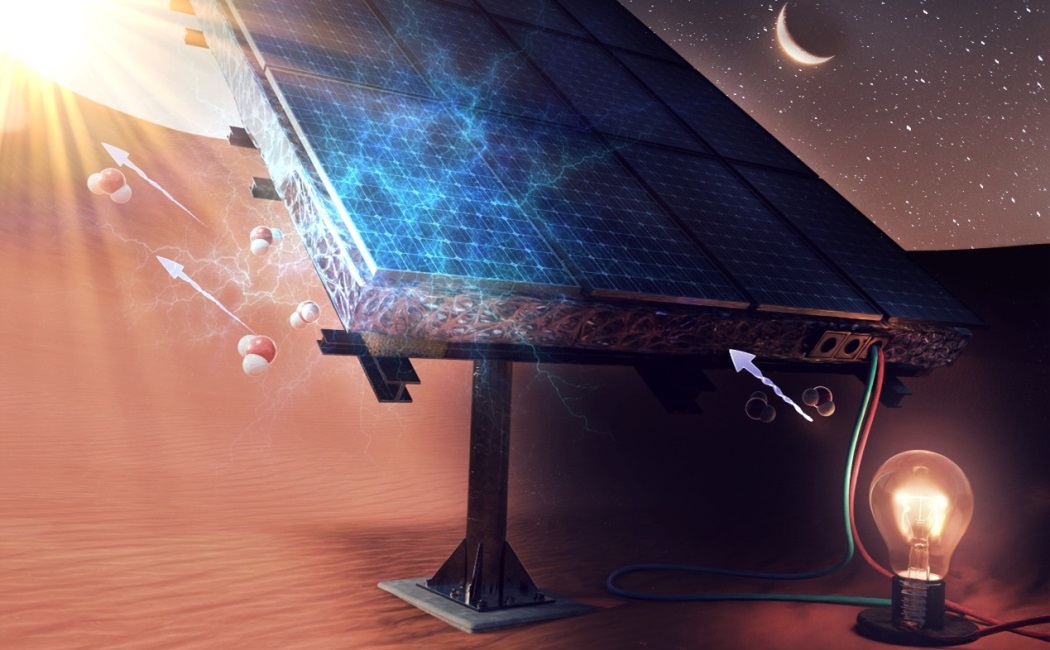
The system integrates a solar panel, a hygroscopic hydrogel layer, and a moisture-driven hydrovoltaic device into one platform. At night, the hydrogel absorbs water from the air. During the day, solar heating drives evaporation from the hydrogel, which cools the PV panel. At the same time, the released moisture and thermal energy enhance the output of the hydrovoltaic unit.
“Conventional solar panels inevitably accumulate heat during operation, and that heat is usually wasted,” Prof. Gan explained. “Our goal was to use this waste heat more intelligently—cool the panel, while also converting ambient moisture and low-grade thermal energy into useful electricity.”
Experiments showed that under one-sun illumination, the hydrogel layer reduced the PV panel temperature by up to 13.5 °C, leading to an approximately 15% increase in photovoltaic output. The hydrovoltaic component also showed about a 150% increase in power output under solar irradiation, benefiting from the combined effects of stable moisture supply and PV waste heat.
The team further demonstrated outdoor operation in Jeddah, Saudi Arabia, where the integrated system maintained electricity generation during both daytime and nighttime conditions. By connecting multiple hydrovoltaic units, the researchers achieved a voltage high enough to power small electronic devices such as LED arrays and sensors.
“The key advance is that we are not only improving solar-panel performance, but also building a multifunctional energy platform that can harvest energy from the surrounding environment,” said Sunmiao Fang, the first author of the study and a postdoctoral researcher in Prof. Gan’s group. “This could be especially valuable for self-powered electronics and distributed energy systems in hot and water-stressed regions.”
The work points to promising applications in off-grid electronics, self-powered sensors, and building-integrated energy systems. More broadly, it suggests a new pathway for solar technologies that combine photovoltaic conversion, passive cooling, and environmental energy harvesting within a single architecture.
The study, titled “Atmospheric-moisture-driven evaporative cooling and concurrent hydrovoltaic energy harvesting in photovoltaic panels”, was published in Energy & Environmental Science.
Link: https://pubs.rsc.org/en/content/articlehtml/2025/ee/d5ee05530j